


Choosing a platform for your newsletter in 2026 means deciding where you’re going to build your media: your blog, your emails, your community and your growth systems.
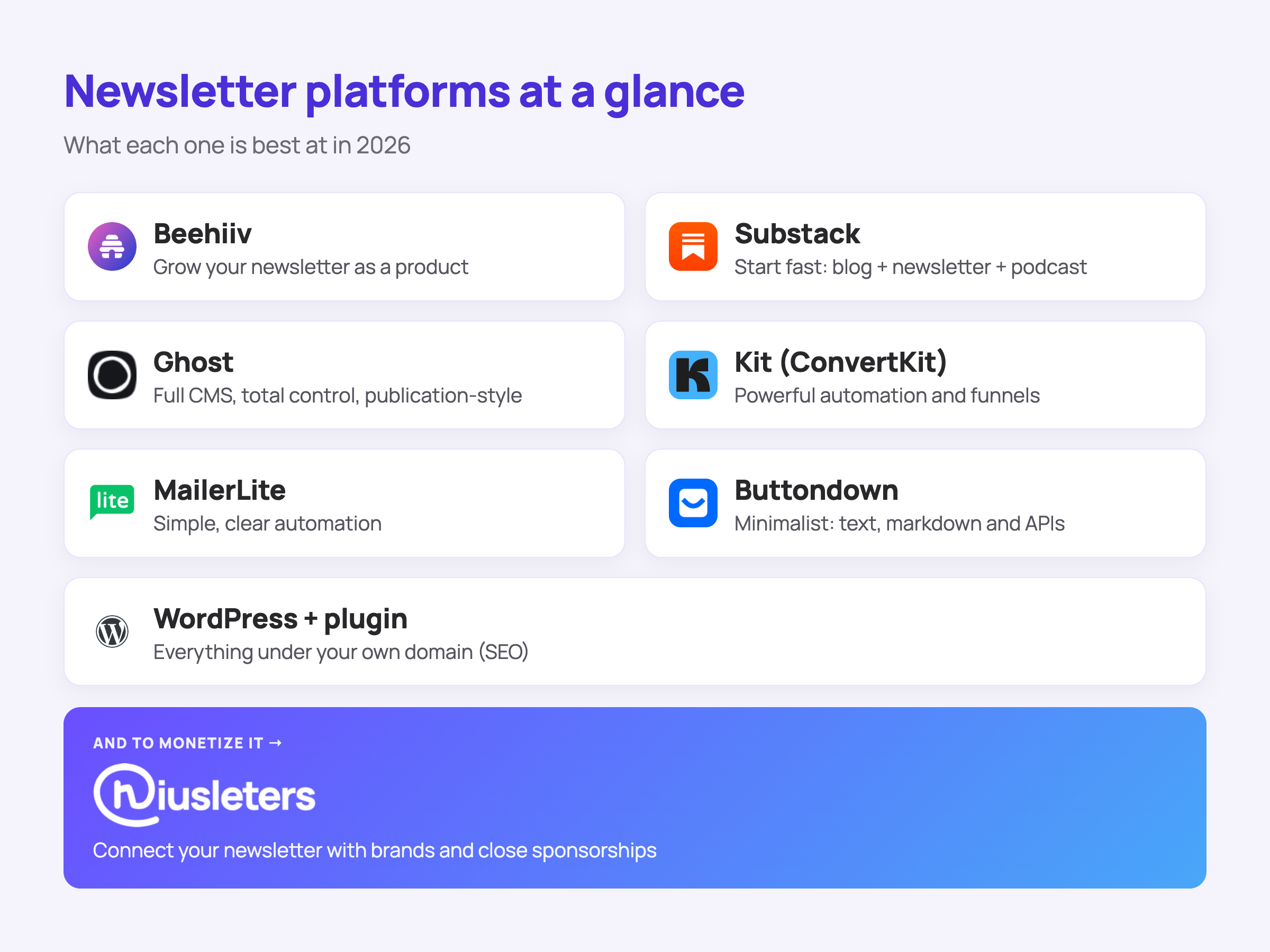
In this guide we compare Beehiiv, Substack, Ghost, Kit (ConvertKit), MailerLite, Buttondown and WordPress+plugin from the point of view of their features and characteristics. These are the technical pieces that help you publish and grow a blog‑style newsletter; on top of them you can add external tools to connect with brands, manage sponsorships or appear in author‑newsletter directories, such as Niusleters, which offers all of this and much more.
Don’t want to read the whole comparison? Try our test to choose a platform, which scores every platform in the directory against your answers, or browse the side-by-side platform directory with pricing verified per provider.
Why “any” newsletter tool isn’t enough anymore
In 2026 it’s no longer just about sending emails: it’s about choosing the ecosystem where your content will live.
- Some platforms are almost media CMSs (Ghost, WordPress), designed for publication‑style sites with a blog, newsletter and members area.
- Others are creator‑first SaaS (Beehiiv, Substack), aiming to minimise friction when writing, publishing and growing inside their own public plaza.
- And others (Kit, MailerLite, Buttondown) work as email and automation engines, expecting the blog and the more “web” part to live somewhere else.
This decision affects your SEO, how AI assistants cite you, your day‑to‑day workflow and how easily you can integrate your newsletter with other products or services.
Publishing model and content formats
What to look at
Here the question is: what can I publish and how is my content presented?
- Do I have a complete blog with sections, homepage and post archive?
- Only email newsletters with a minimal public page?
- Is there support for podcast, video, static pages, etc.?
Quick table: what each platform publishes
| Platform | Blog / own site | Email newsletter | Podcast / audio | Video / lives |
|---|---|---|---|---|
| Beehiiv | Yes, publication‑style site | Yes | Yes | Optional |
| Substack | Yes, integrated blog | Yes | Yes | Yes (TV) |
| Ghost | Yes, full CMS | Yes | Via integrations | Via integrations |
| Kit (ConvertKit) | No, only pages | Yes | Via integrations | Via integrations |
| MailerLite | Yes, simple site | Yes | Via integrations | Via integrations |
| Buttondown | No, minimal pages | Yes | Via integrations | Via integrations |
| WordPress + plugin | Yes, full blog | Yes (with plugin) | Via integrations | Via integrations |
Beehiiv: publication‑style for author newsletters
Beehiiv combines a publication‑style website, newsletter editor, podcast support and static pages in a single dashboard.
You can have a homepage, sections, sales pages and an article archive under a Beehiiv subdomain or a custom domain, keeping a coherent experience between blog and email.
It’s especially useful if you want your newsletter to be the core, but also want standalone blog‑style posts that rank in search and act as entry points to your list.
Substack: blog + newsletter + podcast + video, with the minimum you need
Substack offers a very simple model: each send is a public post on your Substack site, with the option to mark it as subscribers‑only, add audio (podcast) or video/lives via Substack TV.
You get a blog with a post archive, a subscription page and basic sections for podcast and exclusive content, all from the same editor.
If you’re looking for minimum friction to write and publish, this “blog + newsletter + podcast” format is hard to beat in simplicity.
Ghost: full CMS for professional publications
Ghost is a professional CMS designed for media properties: blog, newsletters, sections, pages and member‑only content.
It works like a full content management system: you can design templates, create categories, landing pages and specific sections (for example “Analysis”, “Guides”, “Daily newsletter”).
It’s the natural option if your project looks more like a digital publication than an isolated newsletter.
Kit (ConvertKit), MailerLite and Buttondown: email engine + lightweight pages
Kit offers newsletters, sequences and landing pages, but not a blog CMS: the usual pattern is to keep long‑form content in another tool (WordPress, Ghost) and use Kit as your email and automation system.
MailerLite lets you create newsletters, pages and a simple site, enough for many creator and small business projects.
Buttondown, meanwhile, is text‑first and markdown‑first: ideal if your newsletter is mainly text and your blog lives elsewhere as the “home” of your content.
WordPress + plugin: blog as home, email as a layer
With WordPress plus a newsletter plugin (MailPoet, Newsletter, etc.), your blog is the centre and email is an extra layer: all long‑form content is published under your domain, and the newsletter distributes that content to your list.
This approach is very strong if you already work on SEO and want every indexed piece clearly under your brand.
Automation and workflow
What to look at
Here it’s about how you manage your day‑to‑day:
- Can I automate welcome, onboarding and content series?
- How do I tag and segment subscribers?
- Is the interface for building flows manageable or does it become a nightmare?
Quick table: automation level
| Platform | Visual automation builder | Complex sequences / funnels | Advanced segmentation |
|---|---|---|---|
| Beehiiv | Yes | Yes, for common use cases | Yes, via segments |
| Substack | Basic | Limited | Basic |
| Ghost | No (delegated to integrations) | Depends on external stack | Member management |
| Kit (ConvertKit) | Yes, very powerful | Yes, funnel‑oriented | Yes, tags and rules |
| MailerLite | Yes, simple | Yes, practically speaking | Yes, groups and segments |
| Buttondown | No, light automation | No, delegated to API/scripts | Simple segmentation |
| WordPress + plugin | Depends on plugin | Depends on plugin | Depends on plugin |
Beehiiv: enough automation for most newsletters
Beehiiv has launched an automation builder with triggers, actions and templates for common cases like welcome series and re‑engagement.
Its approach is “powerful enough without being complex”: you can create welcome flows, segment by behaviour and run campaigns that combine email and site, all inside the dashboard.
For an author newsletter or a mid‑size digital business, this automation layer is usually more than enough.
Substack: basic automation, still evolving
Substack has started rolling out simple automations (welcome series, basic rules), but most of the workflow is still manual: you write, schedule and send.
Subscriber management is straightforward: lists, basic segments and engagement stats, without an advanced layer of complex funnels.
It’s perfect if your strategy is based on a recurring send and one or two light sequences, rather than automating the entire funnel.
Kit and MailerLite: automation power for digital businesses
Kit stands out for its visual automation builder, tags and conditional rules, aimed at creators who run courses, products and multiple content flows.
MailerLite offers very clear automations (welcome, recurring campaigns, triggers) with a simpler visual editor, ideal for businesses that want automation without building a mental map the size of a wall.
If your newsletter is tightly connected to funnels and complex sequences, these two will sound especially attractive.
Ghost, Buttondown and WordPress+plugin: offloading automation
Ghost offloads almost all advanced automation to external services (for example email provider + Zapier/Make), so the logic lives in other tools while content and members live in Ghost.
Buttondown provides light automations, but its real strength is the API and CLI, which let you build your own scripts; WordPress+plugin depends completely on which plugin you use and which integrations you add.
This approach is more interesting if you already have a technical stack and want full flexibility.
Growth and discovery
What to look at
- Does the platform have an internal network that recommends your newsletter?
- Does it offer referral features, Boosts, social feeds or directories?
- How do I capture subscribers from outside (landing pages, forms, etc.)?
Quick table: growth tools
| Platform | Internal network / discovery | Referrals / Boosts system | Landing pages / forms |
|---|---|---|---|
| Beehiiv | Yes, recommendation network | Yes, Boosts and referrals | Yes |
| Substack | Yes, Notes feed and directory | Recommendations between newsletters | Yes |
| Ghost | No native network | No native referrals | Yes, via CMS |
| Kit (ConvertKit) | Weak internal discovery | No native referrals | Yes |
| MailerLite | Weak internal discovery | No native referrals | Yes |
| Buttondown | None | None | Yes, simple |
| WordPress + plugin | No native network | No native referrals | Yes, via plugins |
Beehiiv: growth inside and outside the platform
Beehiiv integrates a recommendation network, Boosts and a referrals system that let you grow inside the platform through cross‑promotions.
It also offers landing pages, embeddable forms and one‑click subscription links, making it easy to capture subscribers from social networks, external blogs and collaborations.
In terms of growth‑oriented features, it’s one of the most complete packages for creators.
Substack: social feed and creator ecosystem
Substack has been turning into a social plaza: its Notes feed, newsletter directories and cross‑recommendations allow creators to be discovered and discover others without leaving the ecosystem.
The mix of blog + newsletter + social feed is very helpful if your audience already lives inside Substack and you want to leverage that network effect.
Ghost, WordPress, Kit, MailerLite and Buttondown: SEO + external promotion
Ghost and WordPress lean mostly on site SEO and external promotion (social, collaborations, links from other outlets).
Kit and MailerLite combine landing pages, forms and automations to capture subscribers from blogs, social channels and ads.
Buttondown doesn’t try to handle discovery internally: its philosophy is to be a discreet tool that integrates with your blog or site, leaving growth to your external strategies.
In addition to growth inside each platform and the SEO of your own site, it’s increasingly common to rely on external tools that connect author newsletters with brands interested in advertising. Platforms like Niusleters, with searchable directories by topic, language and audience size, make it easier for your newsletter to be discovered by potential sponsors, regardless of whether you publish on Beehiiv, Substack, Ghost or a WordPress setup with a newsletter plugin.
SEO, AI signals and site ownership
What to look at
- Which domain hosts my content?
- How much control do I have over URLs, meta data and structure?
- Does the platform help my site be the “canonical” source that AI cites, or does that role go to the platform’s domain?
Quick table: domain and SEO control
| Platform | Custom domain possible | Control over URLs and meta | Site’s role in SEO/AI |
|---|---|---|---|
| Beehiiv | Yes | Medium, sufficient | Own site or Beehiiv subdomain |
| Substack | Yes | Limited | Substack site as reference |
| Ghost | Yes | High, full CMS | Canonical site for the project |
| Kit (ConvertKit) | Yes, on landing pages | Basic | Blog usually hosted elsewhere |
| MailerLite | Yes | Basic | Simple site + capture layer |
| Buttondown | Yes, for sending | Low | External blog as canonical |
| WordPress + plugin | Yes | High | Blog/site as main source |
Ghost and WordPress: maximum control as canonical site
Ghost and WordPress let you control domain, URL structure, meta tags, sitemaps, technical performance and schema, turning your site into a clear and stable source for search engines and AI assistants.
This is the most solid scenario if your strategy is to build a strong editorial brand and have your articles referenced directly when someone searches or when an AI model cites sources.
Beehiiv and Substack: optional custom domains, strong ecosystems
Beehiiv and Substack allow custom domains and provide indexable pages, but they remain closed platforms: many publications live under their own subdomains.
Beehiiv has introduced site formats designed so your content looks like a proper website rather than just a newsletter feed, improving its fit as the “home” of your project.
Here you’re balancing ease (ecosystem) and ownership (full SEO control).
Kit, MailerLite and Buttondown: combining external blog + email engine
Kit and MailerLite support custom‑domain landing pages, but long‑form content often lives somewhere else.
Buttondown explicitly assumes that your content will live in an external blog or site and that it’s just the engine for sending and managing subscribers.
For projects where the blog is key and the newsletter is a distribution layer, this approach is often the healthiest long‑term option.
Analytics and reporting
What to look at
- What campaign, site and subscriber metrics does each platform give me?
- Can I see cohorts and behaviour dashboards, or only opens/clicks?
Quick table: type of analytics
| Platform | Campaign metrics | Site / member metrics | Cohorts / advanced panels |
|---|---|---|---|
| Beehiiv | Yes | Yes | Yes |
| Substack | Yes | Basic | No |
| Ghost | Yes | Yes | Depends on integrations |
| Kit (ConvertKit) | Yes | Yes, funnel‑oriented | Yes |
| MailerLite | Yes | Yes, user‑friendly | Partial |
| Buttondown | Yes | No, newsletter only | No |
| WordPress + plugin | Yes (via plugin) | Yes (via external analytics) | Depends on stack |
Beehiiv provides campaign analytics, subscriber cohorts, on‑site behaviour and dedicated panels for podcasts and products.
Substack gives stats for subscribers, growth and engagement per post/newsletter, enough to see which publications work best at a basic level.
Ghost and WordPress integrate very well with external analytics tools, giving you the freedom to build whatever stack fits your project.
Kit and MailerLite are closely aligned with campaign and automation reporting, designed to show content and sales funnels clearly.
Buttondown keeps analytics minimal (opens, clicks, subscriptions), consistent with its minimalist approach and the expectation that deeper analysis will come from your site or other tools.
Integrations and technical profile
What to look at
- Does it have an API, webhooks, CLI?
- Does it integrate well with other tools in your stack (CRM, courses, ecommerce)?
- Do I need a technical profile to really benefit from it?
Beehiiv, Kit and MailerLite offer APIs and integrations with automation tools, ecommerce and course platforms, allowing you to build a fairly complete stack without coding everything yourself.
Ghost and WordPress are almost infinitely extensible: they’re platforms to build solutions on top of, at the cost of needing technical skills or outside support.
Buttondown is the most developer‑friendly: its API and CLI are designed to plug into scripts and pipelines, ideal if you already work with custom automation.
Substack keeps integrations more limited; its main strength lies in the internal ecosystem rather than being an open platform.
UX and support
What to look at
- What’s the learning curve like?
- How pleasant is the dashboard to use week after week?
- How good are support and help resources?
Beehiiv and Substack have invested heavily in modern, simple interfaces, with video tutorials, documentation and creator communities.
Ghost and WordPress require more effort: they’re powerful, but depending on whether you self‑host or use managed services, you’ll need either technical support or time to configure everything properly.
Kit and MailerLite try to balance power and clarity, with educational resources aimed at creators and digital businesses who may not be technical.
Buttondown is minimalist and straight to the point: ideal if you prefer no unnecessary UI layers and something simple, especially if you’re a developer.
Which platform fits best for your type of project?
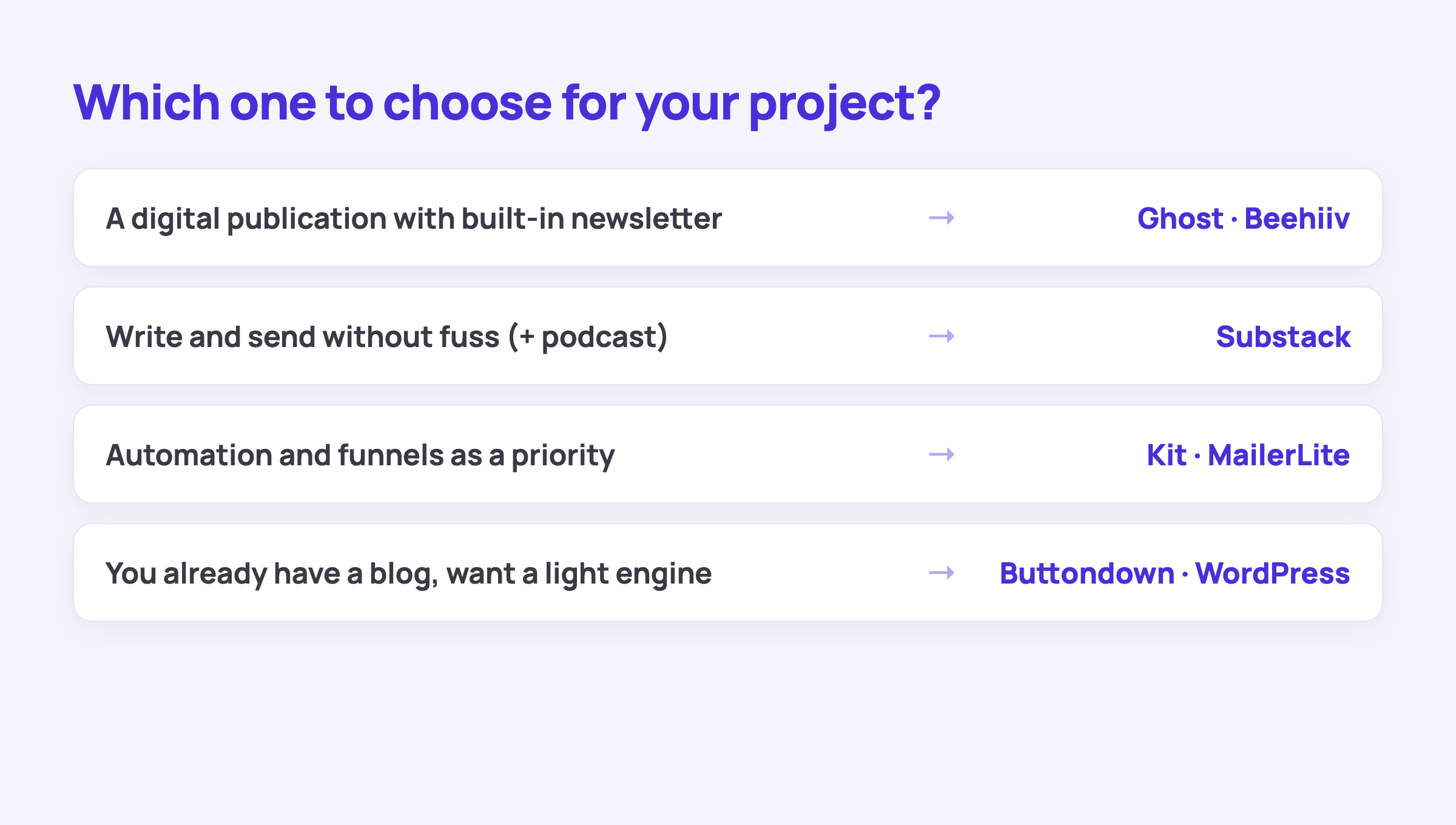
Summing up the features, a quick way to think about fit is:
-
“I want a digital publication with an integrated newsletter.”
Ghost or Beehiiv: Ghost if you want full control and have technical support; Beehiiv if you prefer a creator‑first SaaS with internal growth tools. -
“I want to write and send without overthinking, but still have a blog and podcast.”
Substack: blog + newsletter + podcast + video/lives with a very gentle learning curve. -
“My priority is automation and funnels.”
Kit and MailerLite: email and automation engines, combined with whichever blog tool you prefer. -
“I already have a blog and want a lightweight, controllable newsletter engine.”
Buttondown or WordPress+plugin: Buttondown if you value simplicity and APIs; WordPress+plugin if you want everything under your own domain and don’t mind maintaining the stack.
All of this helps you choose the technical infrastructure: where you write, how you publish and how you grow. On top of that, sponsorship‑based monetisation usually comes as a second layer: this is where platforms like Niusleters, which connect brands with author newsletters and simplify the process of securing campaigns, come in so you can focus on creating high‑quality content while they support you with the commercial side.