

When we talk to brands that have never sponsored a newsletter, the conversation almost always starts the same way: “OK, but what exactly is an author newsletter? And where does my ad show up?”
It’s a perfectly reasonable question. Everyone knows how an Instagram ad or a website banner works, but a sponsorship inside an email is something many people have never seen from the inside. So let’s explain it from scratch, without taking anything for granted.
If you’d rather see it before reading about it, we’ve built a visual guide with a sample email taken apart, where you can tap each part and switch the sponsorship on and off to see the difference.
What is an author newsletter?
An author newsletter is a publication that a person writes and sends by email to the people who subscribed to read it. It usually covers a specific topic (food, personal finance, tech, parenting, travel, marketing…) and goes out on a regular schedule: weekly, every two weeks or monthly.
The comparison that works best is the podcast one: it’s like a blog or a podcast, but instead of you going to find it, it lands straight in your inbox. And, just like a podcast, brands can appear inside it.
Three things set it apart from any other email you get:
- It’s signed by a person with a name, not a marketing department. Readers know them and trust their judgment.
- Nobody gets it by surprise. Every subscriber left their email because they wanted to read it, which is why it gets opened and read carefully.
- Its value is the content, not selling. That’s exactly why people listen when it recommends something.
What an author newsletter is not
This is where the confusion usually lies. An author newsletter is not:
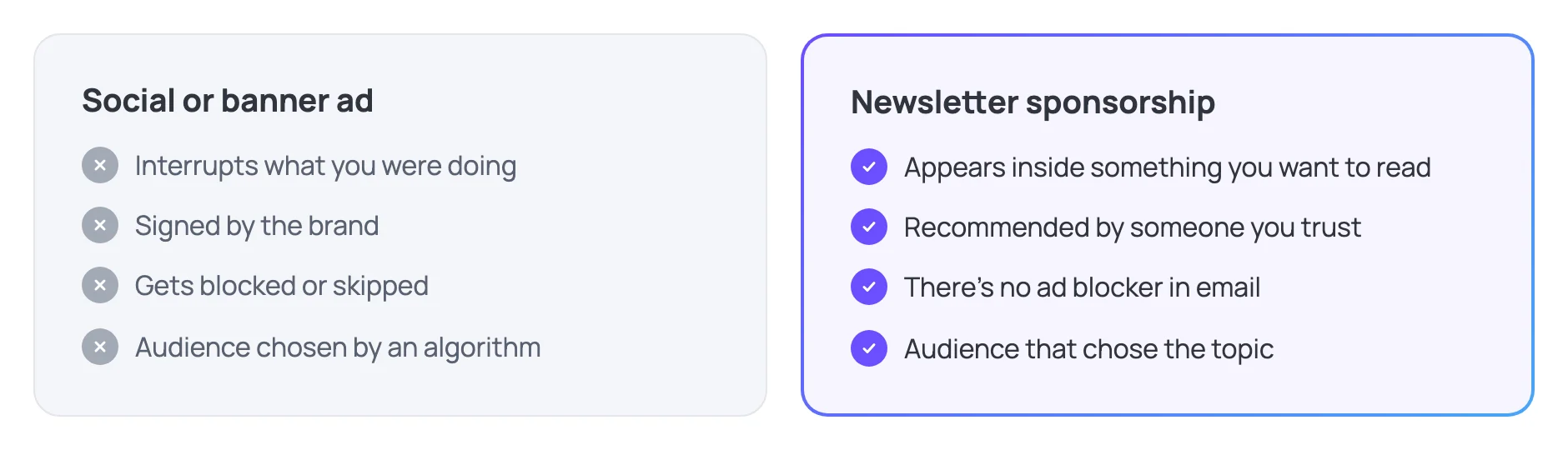
- A company newsletter, the one your online store sends you with this week’s sale. That email talks about its own products; an author newsletter talks about a topic.
- A mass email sent to a bought list. The people who receive it subscribed by choice.
- A social media profile. There’s no algorithm deciding who sees it: if you’re subscribed, you get it.
Where the ad goes inside the email
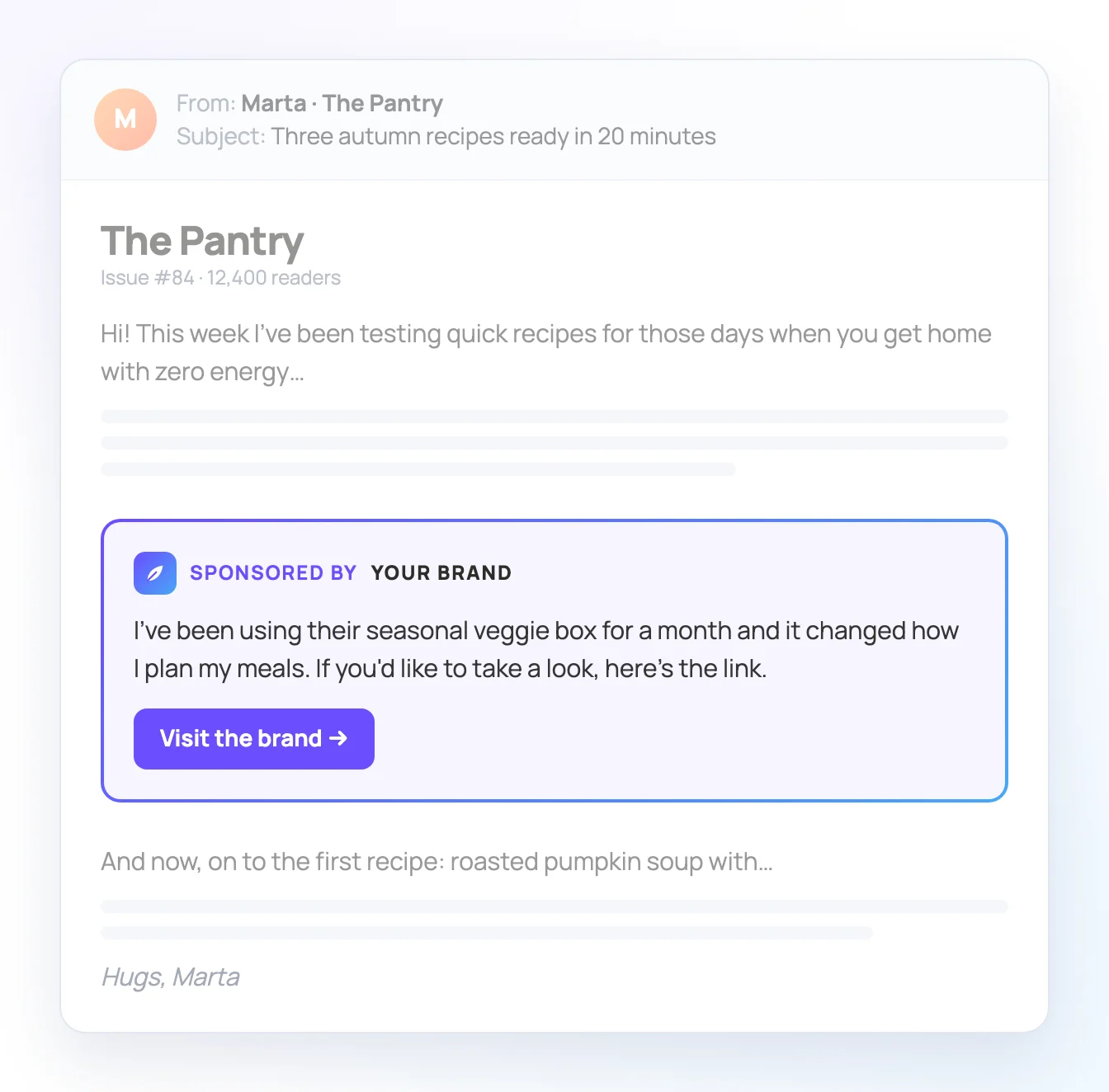
A sponsorship is a space reserved inside the newsletter to recommend a brand. It’s always labelled as sponsored (“Sponsored by…”, “This issue is brought to you by…”), so readers always know it’s advertising.
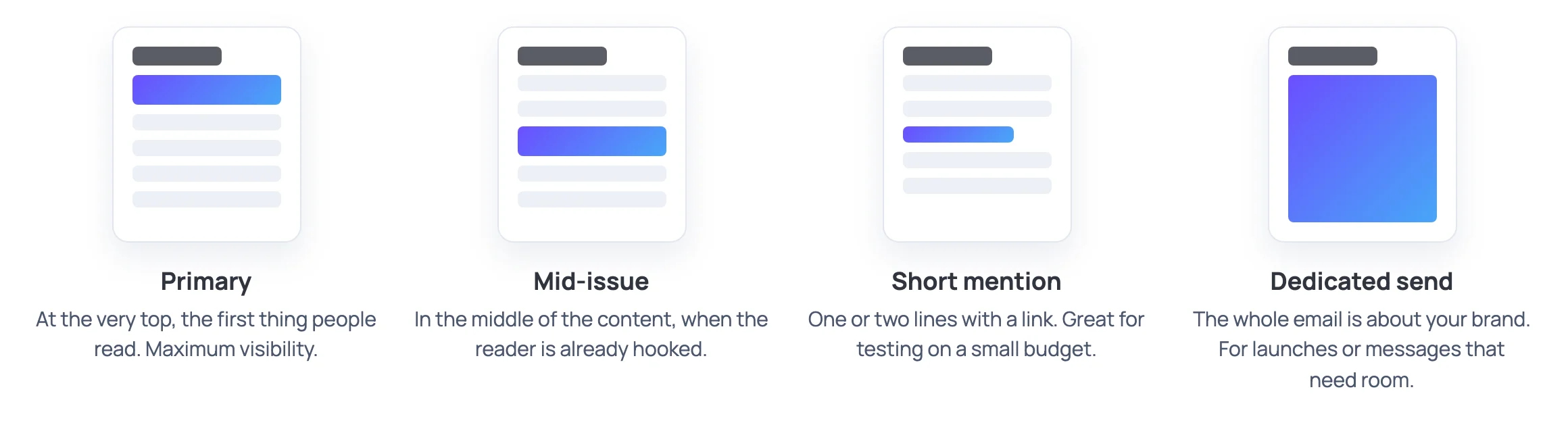
There are four common formats:
- Primary. At the very top, the first thing people read when they open the email. It gets the most visibility.
- Mid-issue. In the middle of the content, when the reader is already hooked.
- Short mention. One or two lines with a link. It’s the most affordable option and the best one for testing.
- Dedicated send. The whole email is about your brand. Used for launches or messages that need room.
A sponsorship usually includes some text, sometimes an image or banner, and a link or button to your site. That link can go wherever you want: your homepage, a specific product, a sign-up form… Adding a discount code is optional; some brands use one and others simply want to get known.
Who writes the ad?
This is the part that surprises brands the most: the ad is usually written by the person who writes the newsletter, based on the information you give them.
Why? Because a text written in their voice sounds like a recommendation, not a pasted-in ad. Readers are used to the way they tell things, and a block that breaks that tone stands out (and gets skipped).
You send a brief with the essentials: what your brand is, what you want to highlight, where the link should go and anything that can’t be said. Then you review the text before it goes out. If you already have a finished text or banner, that can be used too, but it usually works better when the writer adapts it.
How a sponsorship works, step by step
From the brand’s side, the process looks like this:
- You pick the newsletters. Look for the ones covering topics your audience cares about. In our newsletter directory you can filter by topic, language and audience size.
- You agree on format, date and price with each newsletter.
- You send the brief with your brand information and the link (ideally a link with UTM parameters; more on that below).
- You review the text the writer proposes.
- The newsletter goes out to its subscribers’ inboxes, with your sponsorship inside.
- You measure the results with your own analytics.

How much does it cost to sponsor a newsletter?
It mainly depends on how many people actually open each send, the topic and the format. As a reference, in Spain the usual rate is around 100€ per 1,000 real impressions, meaning per 1,000 people who open the email (not per 1,000 subscribers).
We walk through examples in the pricing guide for brands, and you can run the numbers for a specific newsletter with the sponsorship price calculator.
How to tell whether it worked
The most reliable way is to use your own tracking link, for example with UTM parameters, different for each newsletter. That way your analytics show how many visits, sign-ups or sales come from each one, without relying on numbers someone else sends you.
The newsletter can also share the open rate for that issue and the clicks your link received.
To give you an idea of the figures, in a real campaign we managed for a real estate brand, the issues had open rates between 30% and 44.7% and generated 309 clicks to the brand’s channels.
Common mistakes the first time you sponsor a newsletter
- Looking only at subscriber count. What matters is how many people open it. A 5,000-subscriber newsletter with a 45% open rate reaches more people than a 10,000-subscriber one with 15%.
- Wanting the same ad you run on social. A cold banner dropped in the middle of the email wastes the best part of the format: the writer’s voice.
- Drawing conclusions from a single send. As with any channel, repetition helps. The usual approach is to test across several issues or several related newsletters.
- Not using a tracking link. Without one, it’s very hard to know what worked and what didn’t.
Do it yourself or let us manage it?
On Niusleters there are two ways to get started:
- On your own. Sign up for free on the platform for brands, browse newsletters, send them offers and only pay when a sponsorship closes.
- With a managed campaign. If you’d rather not deal with any of it, with Managed campaigns we pick the newsletters, negotiate, help you with the copy and hand you a report with a guaranteed minimum of real impressions.
And if you still have questions about what an author newsletter is, take a look at the visual guide: you’ll have it clear in a minute.